

Have you ever noticed how Netflix seemingly knows what you want to watch next? Or how Amazon suggests things you did not even know you needed but were inclined to want? It’s a bit magical, right? But the magic behind that personalization is something real and strong, and the way AI personalization is coming into play is changing everything.
Consumers today prefer their online experiences to be personal-perhaps more than 71% of consumers expect that companies provide such interactions. If such expectations go unmet, three out of four consumers feel dissatisfied or upset. It’s obvious that old one-size-fits-all experiences have lost their relevance.
This is where AI comes in. By analyzing user’s online behavior such as ; what they click on, what they purchase, how they navigate, etc. It assists apps and websites in displaying the right content to the right person at the right time. Almost like creating a version of your product that learns from each person on an individual basis. AI personalization is now broadly influencing how digital platforms are designed and developed. It is, in fact, transforming product experience for users and driving the growth of business itself through increased user retention and loyalty.
In this blog, we are all going to learn about the way AI personalization works, why it is important today, and its real application in the world. We would also look into the companies that are doing it the best so far, the technology that is backing it, and how you can build more personalized and intelligent experiences for your users from your end.
1: Why Personalization Is a Must-Have Today
Having witnessed the power of AI-driven personalization through its ability to change how individuals experience digital products, it is not hard to comprehend why there is such a rapid shift toward it. What was once a bonus feature has evolved to be the normal default.
- From Generic to Tailored: What’s Changed
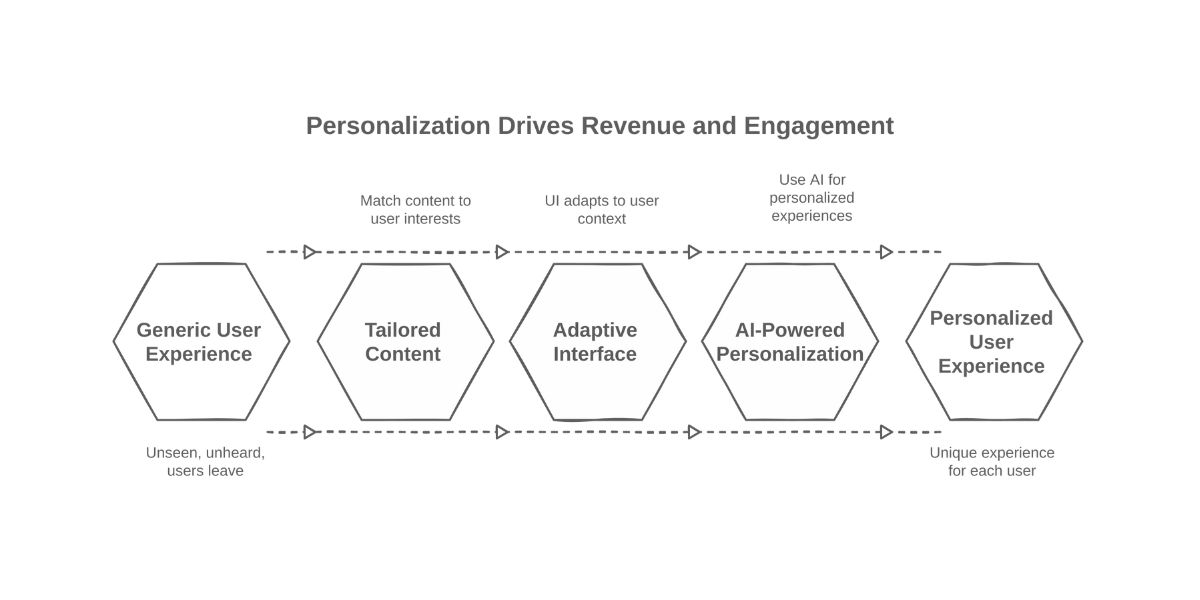
Think back to the last time you entered a website that felt utterly unrelatable to you. Possibly, the content mismatched your interests, or the UI felt clumsy and out of context. You probably did not spend much time there. This is the business price of staying generic: when users feel unseen or unheard, they leave. The bounce rates go up, engagement trickles down, and slowly but surely, customers leave for platforms that seem to resonate more with their needs. - Why a One-Size-Fits-All Experience Doesn’t Work Anymore
With personalization, one seeks to provide one unique experience for one person rather than the same message for the many. Everyone seeks an app or a website that responds to this fundamental human desire. People don’t want to mill through layers of irrelevant options or scroll endlessly to find something that feels right. They want to land on a page and feel that it is theirs, made just for them. - How Personalization Impacts Revenue
And this is where things get even more interesting. Companies that are embracing this shift are not just enhancing customer experience; they are also growing faster. Studies show that fast-growing organizations earn around 40 percent more of their revenue through personalization than those that have not made it a focus. In fact, organizations that invest in customer experience, in general, are seeing revenue growth rates that are almost three times more than their competition.
It’s not just a matter of remaining current. It’s about remaining competitive. With more businesses catching on, the competition heats up. By 2026, nearly a third of all new applications are expected to feature personalized, adaptive interfaces powered by AI. This is indeed a very remarkable leap from just a few years back.
Take Amazon as an example-an entire platform dedicated to delivering something personalized for every user. The homepage, product suggestions, everything alters to suit what you like, what you browse, and what you’ve already purchased. So much has this idea permeated modern ideals that anything less seems slightly outdated now. Amazon didn’t just use personalization to improve its own store; it set a new standard for all online experiences through personalization.
Read: How to Spot Early Signs of Mice and Rodent Infestations in Your Home
2. How AI Drives Real Results
Now that we have discussed the importance of personalization in the modern digital environment, the next step is to see how it’s affecting real business. Beyond meeting expectations, AI personalization is now also taking businesses to far grander results than merely meeting engagement at a surface level.
- Boosting User Engagement:
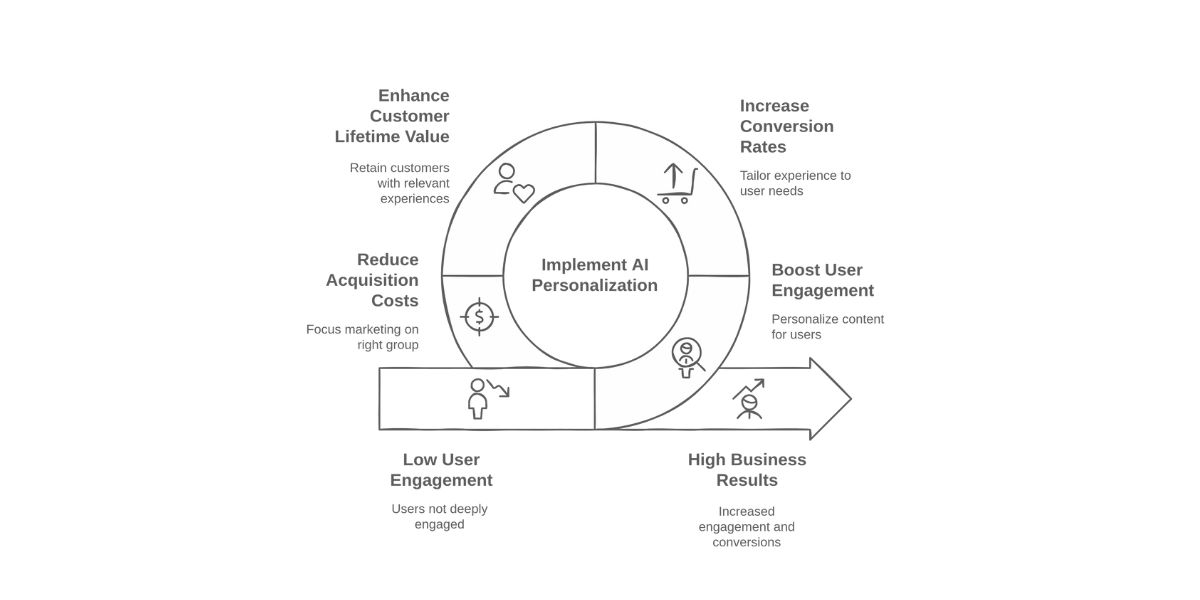
When an app or website acts like it understands a user, they tend to engage more with it. It feels simpler, more meaningful and often more pleasurable. Websites that offer content through AI personalize see about 25 percent increase in user engagement. That also means users aren’t just browsing , they’re engaging more deeply. - Increasing Conversion Rates:
The increased interaction usually results in more conversions. When a user sees what they need to see or is led through an experience that makes them feel tailored to them, they become much more likely to act. HP Tronic, an electronics retailer, experienced an increase in its conversion rate among new customers by 136 percent after implementing AI personalization on its site. - Enhancing Customer Lifetime Value (CLV):
Personalization is also a significant factor in retaining customers. When experiences remain relevant to a customer, chances are they will come back, and even be loyal for quite a longer period. This, in turn, adds something called customer lifetime value, and is thus, very important for any company in the race for sustainable growth. - Reducing Acquisition Costs:
One more advantage is intelligent marketing spend. By using AI, businesses can have alternatives beyond targeting everyone to focus on the right group of people, at the right moment. This helps the campaigns be more effective and cuts the cost of customer acquisition by as much as 50 percent.
In fact, Netflix serves as one of the most telling examples of all this in action. Its recommendation mechanism is an entirely new way to experience discovery. Today, more than 80 percent of what the public consumes on a viewing platform is based on these AI-enabled mechanisms. By promptly helping users find relevant content, Netflix keeps viewers engaged and minimizes churn. It has been estimated that this strategy is saving the company a billion dollars annually.
3. What Personalization Looks Like on Real Websites
Having discussed how AI drives business growth, it comes as no surprise to ask where it’s actually practiced? How does it appear when we use apps or surf websites? Let’s dig in and see what AI personalization looks like when it is working silently in the background.
- Dynamic Product Recommendations:
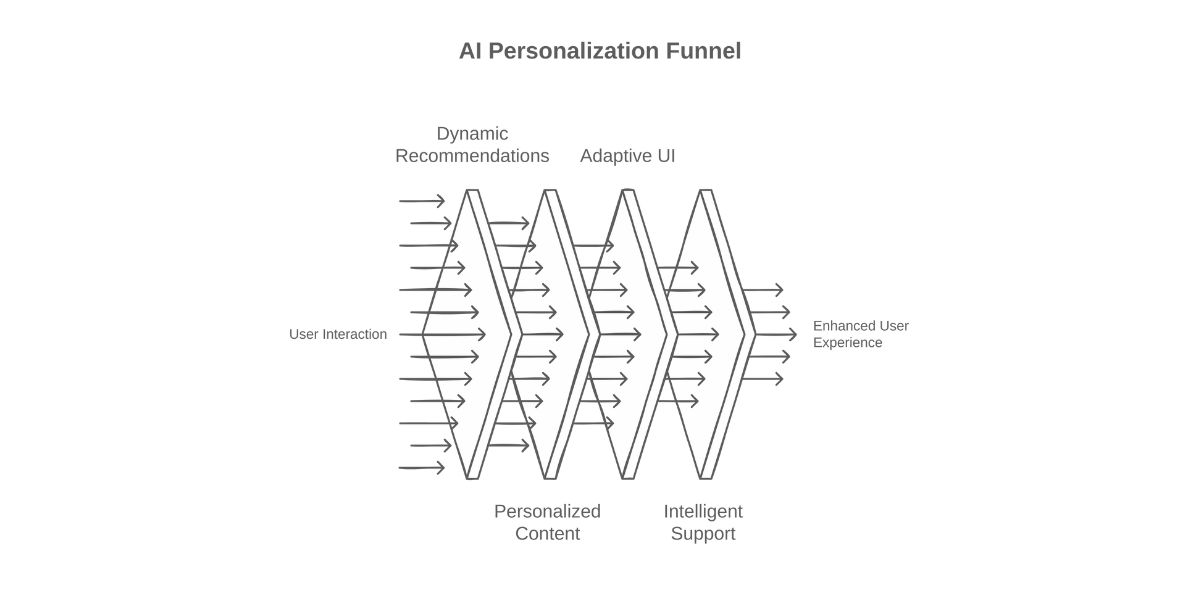
Starting with product recommendations. These go far beyond a basic list of popular items. Artificial intelligence analyzes browsing behavior, consumer purchases, and timing of visits, to suggest products that an individual user is likely to want. For example, the beauty brand Yves Rocher experienced an elevenfold increase in purchase rates after switching from static product recommendations to AI-based recommendations. - Personalized Content & Communications:
Then there’s how content is delivered. From emails and push notifications to articles and product updates, AI tailors messaging based on each user’s interests and actions. Starbucks does this through its AI engine, delivering personalized offers that helped grow its loyalty program and increase engagement. Today, more than half its US revenue comes from these repeat customers. - Adaptive User Interfaces (UI):
The design and ambiance in which websites or apps operate can change depending on the user. Adaptive interfaces respond to the usage patterns of their users, changing layouts and functionalities to make experiences feel more familiar and intuitive over time. - Intelligent Customer Support:
The customer support is changing as well. With AI chatbots, the context is now being understood and the answer is provided. The Myntra fashion site added an assistant that allows customers to introduce open-ended queries, and customers who engaged with that assistant were 3 times more inclined to purchase something.
But how does all this actually pull together behind the scenes? That is where conversion rate optimization platform comes in. These technologies are the unsung drivers of personalization that we encounter, enabling brands to decide what is effective and why. They experiment with layout, measure user behavior, and identify what makes people click, explore, or purchase. Teams receive clarity instead of guessing. They are provided not with assumptions but with evidence. In web and app development, this does not only come in handy, it is also vital. Without this layer, personalization is just decoration. And with it, all experiences are made wiser and in accordance with what the user actually wants.
4. How AI Personalization Works
On the surface, we just discussed how AI personalization is brought to life. It is time to investigate now under the hood. What is really driving these experiences? What makes a platform know what to show, suggest, or say at the right moment?
- The Role of Data & ML:
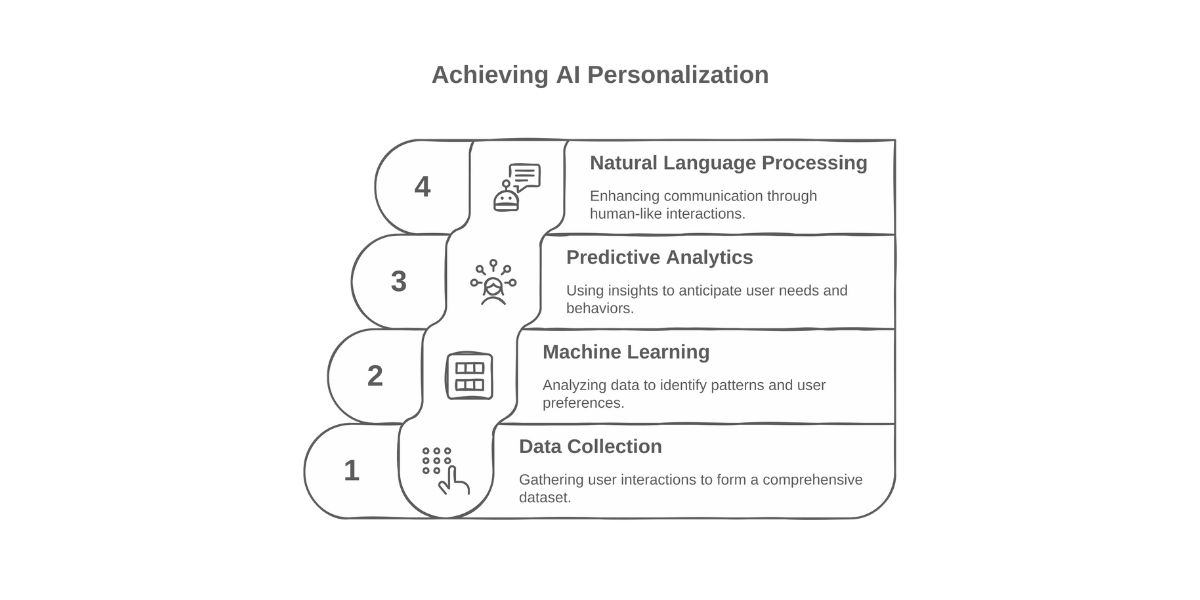
It starts with data. Every click, scroll, and interaction becomes part of a larger story. But data alone doesn’t do much. It needs something smart to make sense of it. That’s where machine learning comes in. These systems learn from patterns, figuring out which features users engage with and which lead to a purchase. The more they observe, the better they get. - Predictive Analytics:
This learning assists platforms in transitioning to predictive rather than reactive. This is what is made possible by predictive analytics. AI attempts to guess what users may require next. An example is Volkswagen which was able to create this model that identifies high intent buyers based on browsing habits as well as interacting with online tools. This allows them to concentrate on their sales where they are most likely to succeed. - Natural Language Processing (NLP):
Natural language processing is another important key piece. This technology enables machines to be able to comprehend and react human-like when you make use of chatbots or voice search. It makes online communications quicker and best performing. Gartner estimates that this efficiency will save up to eighty billion dollars in customer service expenses by the year 2026.
5. The Future of Personalization
With AI getting more advanced, the issue is not what it can personalize but how far it can take it. What would it be like when personalization does not simply tailor the existing material but generates new encounters all by itself?
- Generative AI for Content and Design:
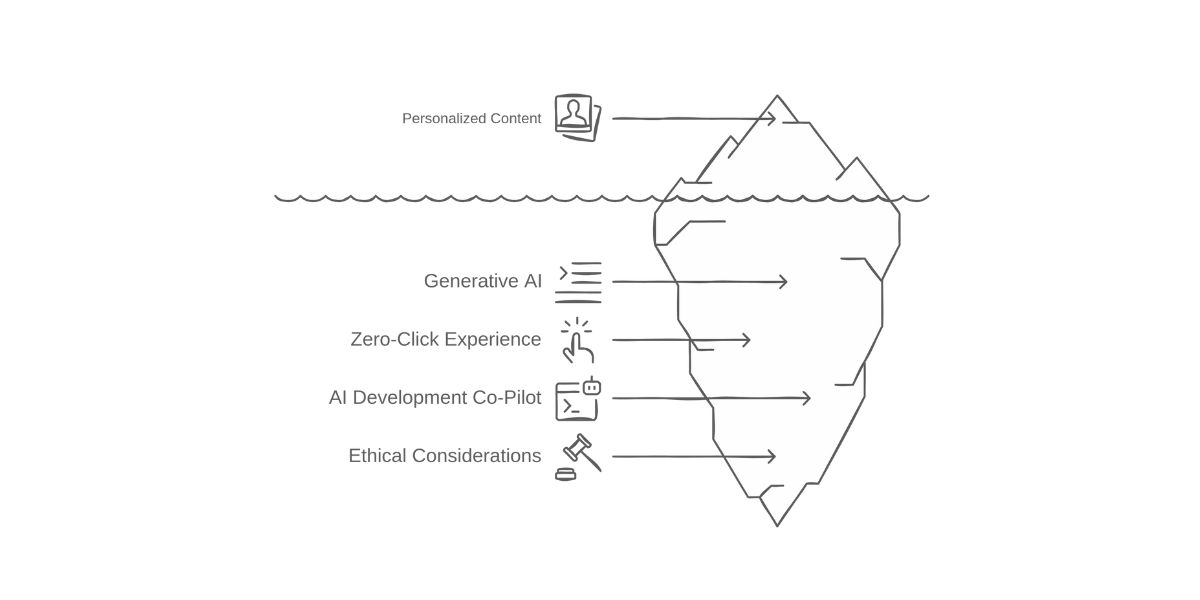
That is where generative AI steps in. Unlike traditional systems that recommend, generative AI builds. Text, images, layouts, and even pieces of code are being generated now for a specific individual user at real-time. That’s a new dimension of both scale and creativity. For example, there was once generative AI from Nutella that would produce seven million unique jar designs- each one distinct and sold out within a month. This is personalization brought to life with imagination and precision. - The “Zero-Click” Experience:
We are also moving toward experiences where users barely need to act. Instead of searching or clicking, content appears just as it is needed. This vision of a zero-effort experience is not futuristic anymore. It is becoming possible as AI systems grow smarter and more predictive, understanding users deeply enough to anticipate rather than respond. - AI as a Development Co-Pilot:
On the development side, AI is emerging as a trustworthy assistant. It can propose functions, create boilerplate code, and even sniff out bugs. This raises productivity and allows teams to turn their focus on innovation instead of routine tasks. - Ethical Considerations:
But with the increasing integration of this technology, so increase the accountability. If a million things are learnt by the systems, it is also imperative that they are developed with transparency and respect towards the user’ privacy. Trust can no longer be an option, It is central to personalization that feels helpful rather than invasive.
Conclusion
AI-driven personalization is no longer a futuristic experiment but a proven to be effective customer engagement, conversion, and long-term revenue driver. Companies that adapt to this transformation are not solely enhancing experiences but also redefining how they engage with their audience across all touchpoints.
The true competitive advantage at this point is the extent to which AI capability is connected throughout product, marketing, and development. Companies that can afford to invest early and strategically will create experiences that are hard to replicate. The future is with individuals who are able to use AI in the digital world to know and serve each customer as an individual customer and not as a part of a segment.
Author’s Bio:
Vidhatanand is the Founder and CEO of Fragmatic, a web personalization platform for B2B businesses. He specializes in advancing AI-driven personalization and is passionate about creating technologies that help businesses deliver meaningful digital experiences.